Blown away: A long overdue documentary recounts the catastrophic explosion that still burns in the memories of Roseburg residents
By Mark Baker
The Register-Guard
Published: Sunday, October 16, 2005
ROSEBURG - It blew people out of their beds. It blew windows out nine miles away.
And it blew Chuck McCullum away, in more ways than one. It still does.
The then-15-year-old was riding home with a friend three miles west of downtown at about 1 a.m. on Aug. 7, 1959, when they felt the earth move under the car and heard the magnificent boom on the other side of Mount Nebo.
"And you looked back over the mountain and you could see the fire coming up over it," says McCullum, standing in the Texaco service station he's worked at - and now owns - since about a year after what locals call "The Blast."
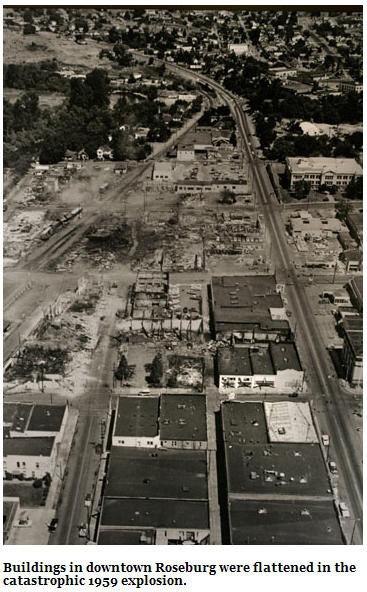
What else would you call something that blew up seven downtown city blocks, blew a mushroom cloud into the sky, killed 14 , injured 125 and caused $12 million in damage in 1959 dollars?
The Texaco station has been at the corner of Southeast Stephens Street and Southeast Mosher Avenue - about 3 1/2 blocks and one street east of where the dynamite-filled truck blew - since 1936. When the explosion rumbled through 23 years later, the station suffered minor damage, McCullum says. But the buildings and the people who were closer to ground zero weren't so lucky.
At 10:30 p.m. Monday, Oregon Public Broadcasting will air "Roseburg Blast: A Catastrophe and Its Heroes." The documentary is 26 minutes long and, according to many whose lives were touched in one way or another by the explosion, 46 years overdue.
Narrated by longtime ABC News correspondent Barry Serafin, a Roseburg teenager in 1959, the film tells the story of one of the worst disasters in small-town America history. Produced and edited by Southern Oregon Public Television's production manager, Victor Dailey, it also has knocked loose memories that, although buried, never really went away.
"It was some night, all right," says Del McKay, 81, with a laugh. McKay is featured in the film and was a 35-year-old radio announcer at Roseburg's KRXL at the time. "We called that our instant urban renewal."
McKay and other longtime Roseburg residents can joke now - sometimes - about the unthinkable tragedy for what was then a city of 12,000 residents.
"The Blast" happened at 1:14 a.m. when a fire that had started inside the Gerretsen Building Supply Co. on Southeast Pine Street ignited 6 1/2 tons of dynamite and other explosives loaded onto a delivery truck parked in front of the three-story building. It not only leveled buildings and blew to bits those nearby, it left a crater 52 feet across and 20 feet deep.
It also changed local, state and federal regulations governing the transportation of hazardous materials - the main one being that you could no longer leave a vehicle carrying explosives unattended. The combination of fertilizer compound and explosives responsible for the Roseburg blast was similar to that left by Timothy McVeigh in front of the Alfred P. Murrah Federal Building in Oklahoma City in April 1995. That explosion killed 168 - intentionally.
The majority of those killed in sparsely populated Roseburg were members of two separate families sleeping in a nearby apartment building. Also killed were a teenage boy who stopped and tried to help put out the fire as his girlfriend ran for help; Roseburg's assistant fire chief, Roy McFarland; and a rookie patrolman for the Roseburg Police Department.
George Rutherford, a driver for the Pacific Powder Co. in Tenino, Wash., had parked the truck there for the night - for delivery the next morning - and walked a few blocks east to the Umpqua Hotel. Most of the load was to be used to blast logging roads along the North Umpqua River east of town.
The film tells how Rutherford ran from Room 207 at the hotel after waking and learning of the fire, and where it was, to try to move the truck. But it was too late. After hearing the blast, Rutherford was held back by bystanders and is quoted as saying, "Let me go, let me go! I've got to go back and see how many people I've killed."
A room devoted to "The Blast" at the Douglas County Museum - in conjunction with the OPB special - illustrates the destruction. Photographs mounted on the wall show an apocalyptic scene with buildings gutted, automobiles thrown aside as if they were toys, and the smoldering remnants of what was once a core chunk of downtown.
"All of a sudden, it looked like the end of the world," says Roseburg resident Norman Neal in the film, a Douglas County Sheriff's Department employee in 1959.
The axle of Rutherford's truck landed 3 1/2 blocks away. Shaped like a boomerang today, it is now part of the museum's exhibit and sits out in the open where you can put your hand to the cold steel and imagine that it must have been a touch warmer a little more than 46 years ago.
The blast was so powerful that a Western Airlines jet flying 17,000 feet over town radioed the Medford airport to report that a nuclear attack might have hit Roseburg.
"They talk about it going 300 feet in the air?" McKay recalls of the mushroom cloud. "I swear it went 2,500 feet in the air."
On a hot, muggy August night, most folks had their windows open as they slept, including the McKay family, where Del McKay and his wife, Virginia, still live today on Northwest Beaumont Avenue just west of Interstate 5 and a couple of miles from the blast site downtown. Over the years, Del McKay had developed a habit where he would grab his tape recorder and head out the door whenever he heard a siren. In the early morning hours of Aug. 7, 1959, as the McKays and their three young sons looked out the window and could see the town on fire, and then were shaken by the explosion, Del McKay grabbed his tape recorder and headed out the door.
This time, however, he went straight to his wife's parents' house to make sure they were all right. He tried to drive his father-in-law downtown to check on his office, but they couldn't get into the area. Del McKay ended up meeting Douglas County Sheriff Ira Byrd - whom he later took back to the radio station for an interview in the early morning hours - and flying in Byrd's plane above the burning downtown to survey the damage and fire.
"One thing I can remember," Del McKay says, "almost every road that led into Roseburg, you could see the (fire engine) lights and see that help was coming."
It was coming from as far away as Eugene as emergency vehicles rushed to the scene.
A scene that is now marked only by a rock with a commemorative plaque attached to it by the Horizon car dealership's service and parts department. A scene that is unrecognizable to the one that was here 46 years, two months and nine days ago.
This story is of course of particular interest to me since it's local history, but it also has a certain relevance when I hear my father tell how he had been downtown Roseburg that night. As a teenager of just 17 in 1959 my father had actually stopped at the local Dairy Queen that night which had been within spitting distance of "Ground Zero." He had returned to his home in Myrtle Creek when the actual blast had occurred, but recounts how even as far away as Myrtle Creek, about 16 miles away if I recall correctly, he'd heard the explosion. The explosion impacted my mother's life in another way as the junior high school she was about to begin classes in was irreparably damaged, forcing her to bus to another school. My grandfather was a local policeman at the time, and recalls receiving a call in the middle of the night to report for duty and spent many weeks after the event serving in any capacity he could helping to keep the peace in the ravaged downtown.
Other relevant links:
http://www.opb.org/programs/program.php?id=17339
http://www.soptv.org/local/RoseburgBlast.html
http://www.roseburgpolice.com/about/images/1959-Blast.jpg
http://en.wikipedia.org/wiki/UN/LOCODE:USRBG